23 Aug 2026
Tracing the Development of Rule Variations in Digital Card Competitions Originating from European Traditions

European card games carried distinct regional identities long before screens entered the picture, and those identities shaped how rules adapted once competitions moved online. Games such as Skat from Germany and Belote from France traveled through community halls and family tables for centuries, each variant anchored in local scoring systems and bidding procedures. When platforms began hosting digital versions in the late 1990s, programmers preserved core mechanics while introducing adjustments that accommodated faster pacing and remote participation.
Early Digitization and Initial Adjustments
Developers working with early internet connections noticed that traditional turn timers created lag issues, so they shortened decision windows and added automated prompts for legal plays. These changes preserved the strategic depth of games while fitting network constraints. Research from the University of Helsinki documented how Finnish programmers working on digital versions of their national game, Piquette, introduced visible hand histories that allowed spectators to follow rule enforcement in real time.
By the mid-2000s several platforms hosted international ladders for games descending from French and German lineages, and governing bodies began logging which local customs survived the transition. Data from the Canadian Gaming Association shows that rule sets for digital Belote retained the original 162-point target while adding an optional “sudden death” round when matches reached time limits during scheduled events.
Regional Variations Meet Platform Standards
Observers note that German communities playing digital Skat often retained the “Ramsch” variant for low-stakes rounds, whereas French-speaking servers standardized on Belote contrée with explicit trump declarations displayed on screen. These differences persisted because platform operators consulted national associations rather than imposing a single rulebook. The European Gaming and Betting Association published guidelines in 2014 that encouraged preservation of regional scoring differences provided all participants received advance notice of the chosen variant.
August 2026 will feature a multi-platform series that pairs German Skat servers with French Belote rooms under synchronized oversight, allowing direct comparison of how each tradition handles misère bids and card visibility. Organizers plan to release anonymized match logs that researchers can use to measure whether the added transparency alters bidding aggression compared with pre-digital records.
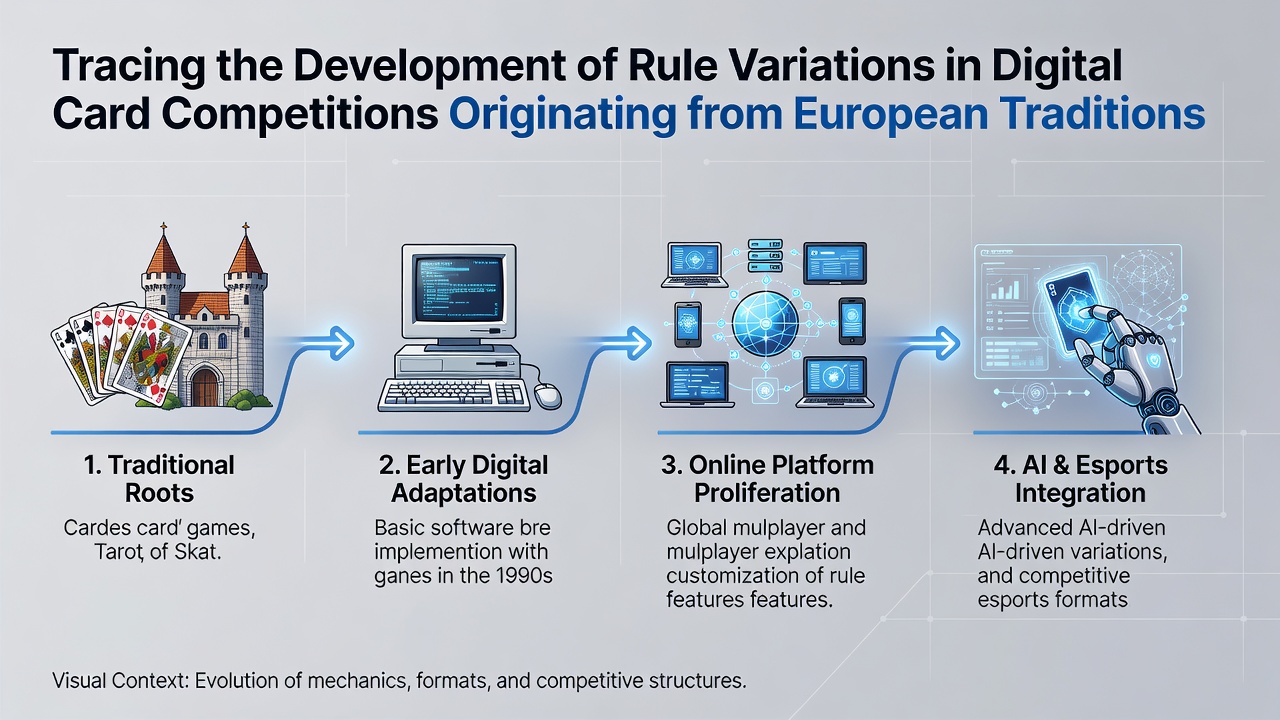
Additional tweaks appeared when mobile clients gained popularity. Developers reduced the number of clicks required for common actions such as passing or raising, yet kept the underlying point thresholds unchanged. Studies conducted at the University of Sydney tracked how these interface simplifications affected error rates among new players entering competitions that originated in European rule sets.
Regulatory and Technical Influences on Rule Evolution
Government agencies across multiple regions required platforms to implement verifiable random number generators and audit trails for scoring calculations. These mandates indirectly influenced rule variations because any change to point allocation had to pass compliance checks before deployment. Australian authorities, for instance, required explicit documentation of how digital versions of trick-taking games prevented collusion through hidden information channels.
Community feedback loops also drove adjustments. When players reported that certain bidding conventions became impractical under shorter timers, organizers tested modified sequences that preserved strategic choice while fitting digital constraints. One documented case involved the addition of a “reserve bid” option in digital Skat that lets participants lock in a value without revealing suit information until later rounds, a mechanic absent from the physical game yet accepted by governing clubs.
Conclusion
Rule variations in digital card competitions that trace back to European traditions continue to reflect the interplay between historical customs and contemporary technical requirements. Platforms maintain core scoring and bidding structures while incorporating features that address latency, transparency, and regulatory compliance. Events scheduled for August 2026 will provide further data on how these adaptations perform under international scrutiny, and ongoing academic reviews will track whether regional distinctions remain intact or converge over successive seasons.